
Mistral Le Chat versus ChatGPT: which AI model should I choose?
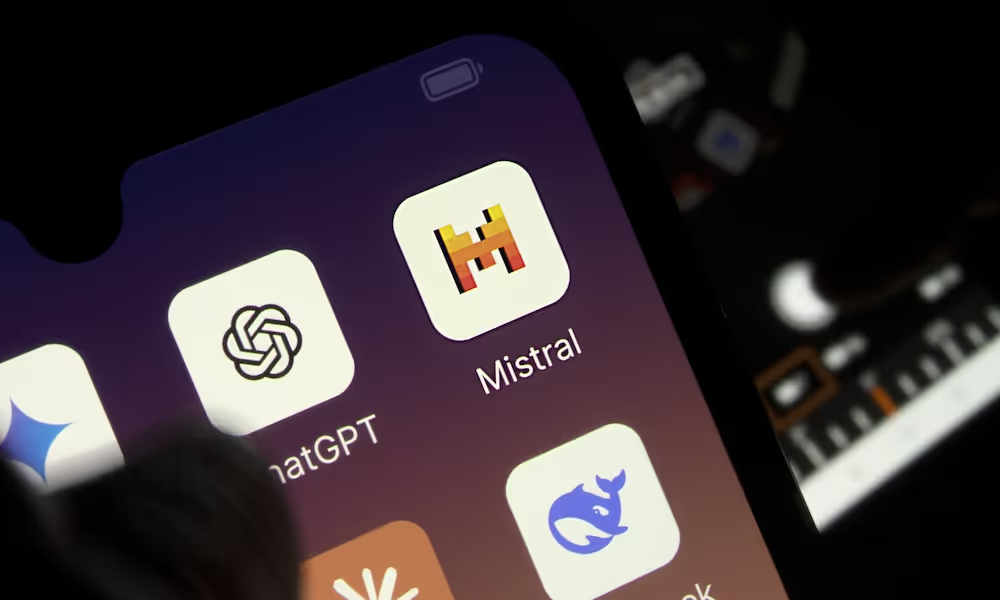
Many organizations are looking for alternatives to reduce dependence on (mostly American) tech giants. In this blog, we compare ChatGPT with Le Chat from Mistral AI. Is Mistral truly a strong European alternative?
Reading time: 5 minutes
Mistral Le Chat versus ChatGPT: which AI model should I choose (and what does it mean for European self-reliance)?
In recent months, “digital dependency” has become a topic of conversation again. Many organizations, and the media, are looking for alternatives to become less dependent on (mostly American) tech giants. In that context, it makes sense that people compare ChatGPT (from OpenAI) with Le Chat, the chatbot from France-based Mistral AI.
In this article, we compare them in a practical way: “what can you use them for in day-to-day work, where does each tool stand out, and what is the best overall choice?”
1) In one paragraph: the core difference
Le Chat (Mistral AI) often feels “light,” fast, and creative for brainstorming, and Mistral clearly positions itself as a company that wants to democratize models. Le Chat offers many features in the free version, with a Pro tier for higher limits.
ChatGPT (OpenAI) is usually the safe all-rounder: broadly useful, strong in structured tasks, and supported by a mature ecosystem of features (such as file analysis and image generation) and product variants.
2) Practical use cases: where do you notice the difference?
A) Fast brainstorming and “creative momentum”
Le Chat is often very pleasant if you want to generate ideas quickly: text variations, new angles for a campaign, concept FAQs, or exploring a topic in a slightly looser style. (Tip: provide a role, target audience, and desired tone to improve output quality.)
ChatGPT can do this very well too, but sometimes feels more “methodical”: it helps you just as much with structure (outline, step-by-step plan, arguments) as with creativity itself.
Who wins here? Le Chat by a small margin, if your work mainly revolves around idea generation and variations.
B) Summarizing and working with documents
Both tools can process documents, but this is where you often notice differences in workflow.
Le Chat supports uploading files and images without extra setup (though limits depend on your plan).
ChatGPT is strong at analyzing files (such as spreadsheets and documents) and turning that analysis into a clear decision, summary, or action-point list.
Who wins here? ChatGPT, thanks to consistent document analysis and output that is often immediately “ready to use.”
C) Writing for work: emails, proposals, policies, internal communication
If you regularly write business content, reliability matters: tone, consistency, repeatability.
ChatGPT typically scores well on consistent style, clean structure, and “thinking along” across multiple steps.
Le Chat can write and vary very quickly, but you may need to steer it a bit more often to achieve the same level of consistency.
Who wins here? ChatGPT.
D) Images and multimodal work
Le Chat includes (according to Mistral) features such as document uploads and image generation within the Le Chat experience.
ChatGPT has rolled out image functionality broadly within ChatGPT.
Who wins here? ChatGPT, mainly because the end-to-end experience is already familiar to many users and often feels slightly more stable.
3) The “EU angle”: becoming less dependent on American providers
This is where Mistral becomes especially interesting for many people. Mistral is a French company and, besides Le Chat as a product, also releases models that are explicitly designed to be tuned, customized, and deployed (people can “set up” the model themselves).
What does that mean in practice?
You can more quickly consider European vendors, contracts, hosting choices, and in some cases even self-hosting or implementing controlled in-house AI tools.
With ChatGPT, you get a very mature product experience, but at its core you remain dependent on an American provider (OpenAI).
Who wins here? Le Chat, if European positioning and flexibility matter.
4) A nuance-driven decision guide (with European self-reliance as a serious factor)
If you focus on pure day-to-day functionality, the key message is: Le Chat (Mistral) has become so mature that it can comfortably replace ChatGPT for most “normal” tasks. Think writing, summarizing, brainstorming, and producing first drafts.
The difference is therefore less and less about “can it do the job?” and more about strategic preference: who do you want to depend on, and how do you want to shape your AI landscape?
Choose Le Chat (Mistral) if these things matter to you:
- A realistic step toward European options: Mistral is a French company, and Le Chat is a tangible, low-friction way to reduce dependence on American AI platforms—without immediately sacrificing productivity.
- Comparable results in everyday tasks: for the average user (texts, ideas, summaries, planning), Le Chat often feels just as useful and fast as ChatGPT.
- Future control: Mistral also publishes models with an open license (including Apache 2.0 for Mistral Large 3), which opens the door to more choice in hosting and implementation if you want more control later.
Choose ChatGPT if you mainly want this:
- The most “all-in-one” experience, with a broad feature ecosystem and many built-in workflows (for many people, it simply feels the most polished).
- Consistent structure and finishing quality for more complex, multi-step tasks and document-heavy work.
Overall winner (with a European note)
If you only look at the broadest set of features and the most uniform user experience between these two models, ChatGPT is still often the “safe default.”
But if you give the European choice more weight, then Le Chat (Mistral) has become the most logical “default.” In many organizations, Le Chat can take over from ChatGPT for most daily tasks, without users feeling like they are downgrading.
Final note: make it measurable
Whichever you choose: run a mini pilot with 5 different tasks (e.g., summarizing, email writing, brainstorming, analysis, policy text), score quality + time saved, and set basic agreements about data use and confidentiality.
Want us to think along in a workshop or advisory engagement (including guidelines for safe use and the EU context)? We can help. Send us a message or email.